What is PRP-Supported Hair Transplantation?
Hair loss is one of the most common aesthetic problems affecting self-confidence in both men and women. With the advancement of hair transplant technologies today, it is now possible to achieve natural and permanent results. However, a method that takes this procedure a step further has been gaining attention in recent years: PRP-assisted hair transplantation.
In this article, we will examine in detail what PRP-assisted hair transplantation is, how it is performed, who it is suitable for, and what advantages it offers.
What is PRP? (Platelet-Rich Plasma)
PRP stands for “Platelet-Rich Plasma.” A small amount of blood is taken from the patient and processed to separate the plasma component. This plasma contains a high concentration of platelets and growth factors.
Platelets are natural cells that facilitate tissue regeneration and healing. For this reason, PRP therapy is frequently used not only for hair loss but also for skin rejuvenation, wound healing, and orthopedic treatments.
How is PRP-Supported Hair Transplantation Performed?
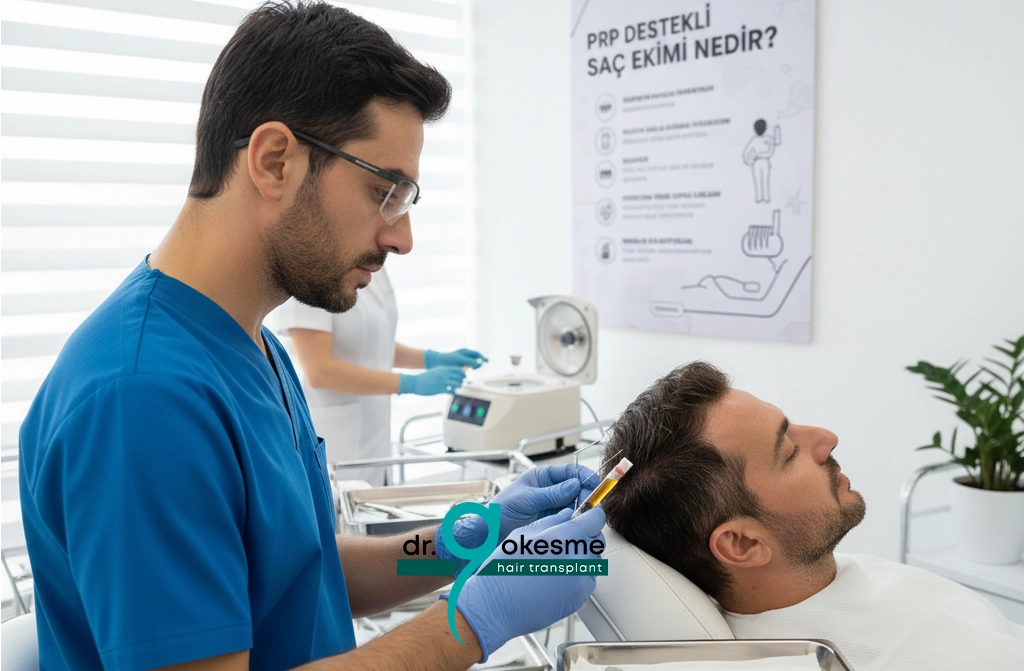
PRP-assisted hair transplantation is performed in conjunction with either the classic FUE or DHI hair transplantation techniques. The process consists of the following steps:
- Blood Collection: The procedure begins with drawing a small tube of blood from the patient.
- Centrifugation Process: The collected blood is spun at high speed in special devices to separate the plasma component.
- PRP Preparation: The obtained plasma is prepared for treatment thanks to its high platelet concentration.
- Hair Transplant Procedure: The classic hair transplant process (grafting from the donor area and transplanting) is performed.
- PRP Injection: After the transplant procedure is completed, the PRP solution is injected into both the transplanted area and the donor area.
This procedure accelerates the attachment of transplanted hair follicles, shortens the recovery period, and supports stronger hair growth.
The Effects of PRP on Hair Transplantation
The main reason for using PRP in hair transplantation is that it supports cell renewal through growth factors. This enables:
- Hair roots adhere more easily.
- The duration of redness and scabbing after October is reduced.
- Less shock loss occurs.
- New hair grows thicker and stronger.
- Blood circulation increases, nourishing the scalp.
In short, PRP acts as a natural accelerator that supports hair transplantation.
Who is PRP-Supported Hair Transplantation Suitable For?
PRP-assisted hair transplantation is generally recommended in the following situations:
- People with advanced hair loss,
- Individuals who have previously undergone hair transplantation and wish to strengthen their hair,
- Individuals with weak hair roots and a slow healing process,
- People who smoke or have poor circulation,
- Patients experiencing hair thinning in women.
However, a specialist hair transplant doctor must perform an analysis before the procedure. Since each individual’s hair structure, type of hair loss, and skin condition are different, personalized planning is required.
Advantages of PRP-Supported Hair Transplantation
PRP-assisted hair transplantation offers many advantages over traditional methods:
- Natural healing process: It is completely natural and free of side effects because it is obtained from the person’s own blood.
- Faster recovery: PRP injections promote rapid tissue regeneration.
- Improved hair quality: New hair strands are thicker, shinier, and healthier.
- Reduces shock loss: Temporary hair loss after harvesting is reduced.
- Reduces the risk of infection: PRP also contains immune cells, which reduces the risk of local infection.
- Natural results: Hair transplants supported by PRP offer a more natural appearance.
How Many Sessions of PRP Treatment Are Required?
After PRP-assisted hair transplantation, 1 or 2 additional PRP sessions are generally recommended. These sessions are usually performed at 1-month intervals. The aim is to maintain the nourishment of the transplanted roots and support the hair growth process. In some patients, regular PRP maintenance every 6 months is also recommended. This helps strengthen existing hair.
The Process After PRP-Supported Hair Transplantation
PRP treatment after hair transplantation accelerates the healing process. However, there are some points to consider:
- Hair should not be washed for the first 3 days.
- Avoid sunlight and dusty environments.
- The PRP sessions recommended by the doctor should not be skipped.
- Healthy eating and drinking plenty of water support the strengthening of hair roots.
Scaling decreases in the first 2 weeks, and shock loss may occur in the 3rd month. New hair growth becomes visible from the 6th month onwards. Full results are achieved by the 12th month.
How Long Does PRP-Supported Hair Transplantation Take?
The procedure duration varies depending on the number of grafts to be transplanted. Average:
- Hair transplant procedure: 6–8 hours
- PRP treatment: 30 minutes
This procedure is completed in a single session. PRP is administered on the day of the procedure and can be supported by follow-up sessions as desired.
PRP-Supported Hair Transplant Prices (2026)
PRP-supported hair transplant prices vary depending on the clinic, the doctor, the number of grafts used, and the quality of the PRP system. As of 2026, PRP-assisted hair transplant prices in Turkey range from an average of 30,000 TL to 80,000 TL. However, the clinic’s expertise and the technologies used should be the deciding factors rather than price. PRP can become ineffective if not applied correctly.
Result: Natural, Strong, and Long-Lasting Results with PRP-Supported Hair Transplantation
PRP-enhanced hair transplantation is one of the most effective innovations in the field of hair transplantation in recent years. By utilizing the body’s natural healing mechanisms, it accelerates the anchoring and growth of hair follicles. Using growth factors derived from your own blood, it enhances hair transplantation results, making them stronger, more natural, and more permanent. If you want to accelerate post-transplant healing and achieve maximum results, PRP-enhanced hair transplantation is the ideal choice for you.